I thought I would let you know what I've been doing in gaming lately.
First off, I can confirm now that I am running four games at Gen Con this year for Goodman Games as a Judge for Dungeon Crawl Classics. DCC is a go-to system for me, as it is what I typically run and play at conventions, and convention games are pretty much 90% of what I get to do in gaming. I think it's got a great mix of old-school and new-school mechanics conventions, and the rules have been written in order to produce a very definite flavor of game.
If anyone reading this is going, I am running Escape From The Purple Planet, The Jeweler That Dealt In Stardust, Caverns of Thracia, and my own adventure, The Temple of Laserface and the Kung-Fu Masters of the 4th Dimension.
The links above are to the event pages.
Although I have run it twice at GaryCon already, I've officially started actual writing for The Temple of Laserface and The Kung-Fu Masters of the 4th Dimension, which will be my first written adventure, assuming it sees the light of day. I am still not 100% sure whether I will keep it system-neutral or specify a rules set. Candidates are DCC, Lamentations of the Flame Princess, or Swords & Wizardry. It would certainly be the easiest to specify no system, as then I wouldn't have to worry about licensing or trademarks. But I feel like the flavor of the game lends itself towards DCC or LotFP.
Before I leave the topic of Gen Con, I will also be excited to hopefully get to meet some of the creators behind Lamentations of the Flame Princess, one of my favorite rules sets and probably my favorite publisher.
In the regular gaming front, I'm also playing in a weekly RuneQuest 2 game on Google+, and have been since the end of 2016. I think the system is pretty good, although I have reservations about Glorantha as a setting, Half a year of playing, and I still don't have a good grasp on it. Ask me the difference between Pavis and Prax, and my eyes will glaze over.
A setting that I am much more drawn to is that of Tékumel. I've started reading Man of Gold, Prof. M. A. R. Barker's first Tékumel novel. It's a bit early, but I think that setting is much more my jam, since there's virtually no aspects of medieval Europe present. It is all heavily inspired by Mesoamerica, India, and Middle Eastern cultures.
Now I'm hoping to play in a Tékumel campaign, but I am reading through The original Empire of the Petal Throne fairly slowly, in the hopes of familiarizing myself with the most basic aspects of the setting. More to follow as I learn more about it, but I have just finished reading through the EPT introduction, and I'm going to see what the rules are like. I also have a digital copy of Jeff Dee's Bethorm, but I feel like I should stick to one source as I learn what's what on Tékumel. If nothing else, I will at least be well armed for the next U-Con convention in November.
Wednesday, May 17, 2017

Monday, May 1, 2017
Some Progress
My adventure is coming along, slowly but surely. I am currently writing random encounters for the journey to the main location. Already I am up to like about ten pages. I think that everything I've written thus far is a cool idea that might inspire something. At the same time, I'm worried about being too verbose.
Does anyone even run modules as written?
Here's a recent drawing. I am thinking about incorporating it somehow.

You have already seen this on my instagram;
@dommephoto
I am gradually shifting that feed from photography (my old hobby) to my boring ass drawings of game stuff. I like the @dommephoto name though so I'm keeping it.
Anyway, sorry for the brief post. If I keep talking about this project, then there's less of a chance I'm going to let it die.
Does anyone even run modules as written?
Here's a recent drawing. I am thinking about incorporating it somehow.
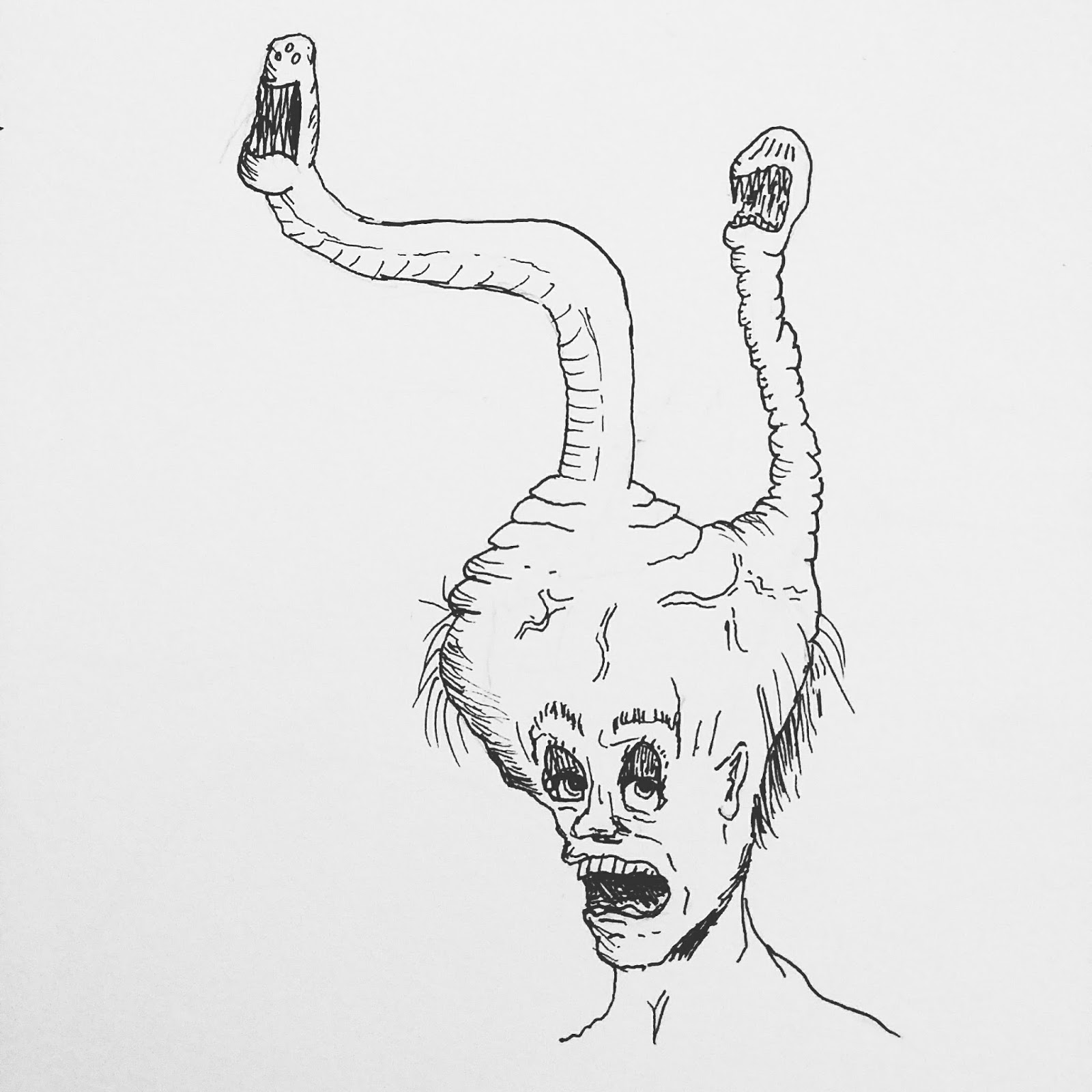
You have already seen this on my instagram;
@dommephoto
I am gradually shifting that feed from photography (my old hobby) to my boring ass drawings of game stuff. I like the @dommephoto name though so I'm keeping it.
Anyway, sorry for the brief post. If I keep talking about this project, then there's less of a chance I'm going to let it die.
Sunday, April 23, 2017
Beginning of a Project
Time.
Measured by grains of quartz passing through glasses on the bureaus of viscounts and desks of diplomats. Calculated by the elaborate skeleton of the galaxy flexing and churning with exact precision. This our ancestors have grown to know, predict, decode. Fingers on the pulse of the universe, letting it tell us when we are, despite its inconceivable indifference.
It may be calculated by the stars and sand. But the behemoth of time cannot be suggested, coaxed in one direction or another. It does not listen to pleas and desires. It does not monitor toil, sacrifice, jubilation, or suffering. It lumbers ever onward. So we know.
Or believe.
The sands of the hourglass are passive, predictable and driven by simple forces. The drip of blood and the tumble of sand are both regular and measurable, though the dynamics change. Viscosity and coagulation. The smell of rust and the hints of life.
But blood lives, breathes, and decays. Unlike the crushed crystals of sand, its energy is secret. Behind a cupric red façade lies a host of energies that the Great Skeleton did not know before, but it unwittingly desires. Therein lies the key to the impetus, a hidden motivator. For the very universe itself to turn its head slightly in response to what it thought it heard, smelled, tasted.
Where there exists a wanting, a will forms.
And so a will can be broken.
Wednesday, January 11, 2017
Gameable Ideas 1
So I'm trying to think of what to do with this blog, and I'm not coming up with ideas. So I decided to try coming up with ideas for gameable content and I'm going to use this post as a dumping ground. Note: Please give me feedback. Do these ideas suck? Is this concept interesting? Is anybody listening? Etc.
Worm farms have developed in the seedy underworld. Fat druglords keep spaghetti-like piles of them in jars with fragrant mulch, so that snuffing a worm will not be such a turnoff. Plush couches and pillows are provided so your body can writhe in the height of comfort
This approach can also add an extra dimension to NPCs within the guild beyond the usual thieving stuff. How closely do they follow the principle of giving back to the faithful? Are they more likely to target worshipers of a rival god? What about holy days; is it forbidden to steal on those days? Or maybe the deity forbids the use of poisons/blades/etc.
Narcoworms
From exotic lands, a species of worm that feeds on plant matter and excretes a mildly toxic waste through its skin. The toxin is also an hallucinogenic narcotic. Over time emerged the practice of guiding a worm up one's nostril to expedite the toxin's delivery to the blood-brain barrier. Nothing short of pure ecstacy as you fall down on the floor and writhe for a while.Worm farms have developed in the seedy underworld. Fat druglords keep spaghetti-like piles of them in jars with fragrant mulch, so that snuffing a worm will not be such a turnoff. Plush couches and pillows are provided so your body can writhe in the height of comfort
Game possibilities:
- Worm farms are a new threat to established pleasure merchants (opium dens, bordellos, etc.). PCs get to deal with consequences of the changing economy.
- A new side effect is taking hold thanks to a worm mutation. Some hardcore wormheads are getting turned into illithids.
Thieves Guild (Variant)
So every decent city has a Thieves guild. it's like having a Buffalo Wild Wings. For an interesting take on one, have the Guild be (tied to) a religious order. You see, being a thief is not about gaining something material, it's about depriving someone else of something they value. And some people value their material possessions more than they value their relationship with Insert-Deity-Here. The wealth that the Guild accumulates is redistributed to the congregation and faithful.This approach can also add an extra dimension to NPCs within the guild beyond the usual thieving stuff. How closely do they follow the principle of giving back to the faithful? Are they more likely to target worshipers of a rival god? What about holy days; is it forbidden to steal on those days? Or maybe the deity forbids the use of poisons/blades/etc.
Fungolepsy
There exists a fungus creature that emits spores thrice per day, or whenever subjected to a slashing wound. there is a 20% chance that those in the immediate vicinity of the spores will contract fungolepsy.
The spores spread to various areas inside the body and do not interfere with normal body functions. However, they feed on melatonin in the bloodstream. For every day that a character has contracted fungolepsy, they lose an additional 1d6 minutes of sleep as the fungus spreads. They may not notice until a few days or even weeks have gone by. If your game does not have rules for sleep loss, roll a number of d6's equal to the number of hours of lost sleep. For each 5 or 6 rolled, you get a -1 penalty to all rolls, and you lose 1 hp from the total that you would have healed due to rest.
Once the daily sleep loss has accumulated to more than 4 hours (240 minutes), the character will begin to hallucinate periodically. Once there is total (8 hours) sleep loss, the character will die in CON/2 days. To be cured of fungolepsy, a character needs to find a specific fungicide which is safe to drink.
Due to the varying nature of campaign worlds, the GM shall decide the effects of a character trying to use magical sleep in order to counteract the effects of fungolepsy.
Tuesday, January 3, 2017
Follow-up Goal for 2017
Ah, yes... regarding the previous post, I forgot all about another goal I had for 2017. That is, I would like to practice my fantasy drawing. Below are some examples of what I did in 2016.


Another Iron Coast image, this was my attempt at drawing the Shroom Sultan. [edited:] The Sultan rules over all the intelligent fungi in the area he occupies, and his presence defines the boundaries of the sultanate. He is personified here on a throne of sorts. The criss-crossing lines in the background are a poor attempt of representing the network of fungus that constitutes the sultanate/sultan.

Sort of an Iron Coast image, this sketch was inspired from that time when the party attended an Orroztalani feast and ate the succulent meat of a giant centipede, and we all had a telepathic conversation with our new temporary mind powers.

From one of my last sessions of ACKS, this was a wizard character for a Crusades-era game run by one of my fellow players in the Iron Coast game. Real life has torn me away from the group, but I understand the game is still going strong. Ultimately, I'm not sure if I'm a fan of the system enough to revisit it given the other games I have on my shelf.

I decided to try watercolor painting as well, although this Beholder is watercolor and the background is acrylic. I might try more painting in the future, but I didn't like this one so much, with exception of the how the teeth came out. Standard D&D monster, too, and not enough lighting consideration in the scene.

It was at this point that I thought I might actually be getting better. This was a generic pygmy dude, maybe appropriate for +Kiel Chenier's new Blood In The Chocolate now that I think about it... Anyway, this was done (a) without a pencil sketch first, (b) entirely with a brush instead of a pen, (c) using an ink wash for shading, and (d) entirely in under ten minutes.

My last real drawing of the year, this one started off by drawing some lines on a sketchbook page while I was waiting on a layover in some airport. I think it might have been Salt Lake City. Anyway, I finished up the inking that evening in the hotel room, just before Game 7 of the World Series started. This wasn't for anything in particular, but I can safely say I was trying to channel +Gennifer Bone while I was working on it. When I posted it, I got a lot of compliments on the feet, which is cool because I didn't use any reference images while I was drawing this one.
So yeah, I think I should try to keep up my drawing during the new year. Maybe it will also help my gaming.

So this the one that started everything. This was for +Adam Muszkiewicz's Iron Coast game (ACKS). I was using a +Dyson Logos B/X character sheet which had a big blank spot for a character portrait, and I felt it was a waste if I didn't draw something in it. I looked for a dwarf drawn by +Stefan Poag (my favorite contemporary pen-and-ink artist) and I found an inspiration image.
Edit: Found the sheet I used above. Click this link to go to Dyson's Character Sheet page, then scroll down to where you see "Elaborate B/X Dungeons & Dragons or Labyrinth Lord AEC Sheet"

Another Iron Coast image, this was my attempt at drawing the Shroom Sultan. [edited:] The Sultan rules over all the intelligent fungi in the area he occupies, and his presence defines the boundaries of the sultanate. He is personified here on a throne of sorts. The criss-crossing lines in the background are a poor attempt of representing the network of fungus that constitutes the sultanate/sultan.

Sort of an Iron Coast image, this sketch was inspired from that time when the party attended an Orroztalani feast and ate the succulent meat of a giant centipede, and we all had a telepathic conversation with our new temporary mind powers.

From one of my last sessions of ACKS, this was a wizard character for a Crusades-era game run by one of my fellow players in the Iron Coast game. Real life has torn me away from the group, but I understand the game is still going strong. Ultimately, I'm not sure if I'm a fan of the system enough to revisit it given the other games I have on my shelf.

I decided to try watercolor painting as well, although this Beholder is watercolor and the background is acrylic. I might try more painting in the future, but I didn't like this one so much, with exception of the how the teeth came out. Standard D&D monster, too, and not enough lighting consideration in the scene.

It was at this point that I thought I might actually be getting better. This was a generic pygmy dude, maybe appropriate for +Kiel Chenier's new Blood In The Chocolate now that I think about it... Anyway, this was done (a) without a pencil sketch first, (b) entirely with a brush instead of a pen, (c) using an ink wash for shading, and (d) entirely in under ten minutes.

My last real drawing of the year, this one started off by drawing some lines on a sketchbook page while I was waiting on a layover in some airport. I think it might have been Salt Lake City. Anyway, I finished up the inking that evening in the hotel room, just before Game 7 of the World Series started. This wasn't for anything in particular, but I can safely say I was trying to channel +Gennifer Bone while I was working on it. When I posted it, I got a lot of compliments on the feet, which is cool because I didn't use any reference images while I was drawing this one.
So yeah, I think I should try to keep up my drawing during the new year. Maybe it will also help my gaming.
Monday, January 2, 2017
First Post of 2017
Lo, it has been a long time since I've reached out with any news. Last time I was here I was comparing RuneQuest 2 and RuneQuest 6. Well, I've been away for personal reasons—namely, work has been exceptionally busy, we bought a home, and we had our first child. Weekends are completely dead to me due to parenting responsibilities, but I have been able to find a magnificent group to play RuneQuest 2 with. The main reason is that we only game for two hours, and it's on a weekday, which means I have a narrow window when I'm the only one awake. I might make future use of this window to try running my own game on a different weeknight, which leads me to my topic.
My RPG Goals for 2017:
Yes, here will be the space where I outline my goals for the coming year, and where I can turn my eyes in December to evoke substantial disappointment.
1. Run an actual campaign via G+.
I think that I need to decide what to run, then build up a group based on both my schedule availability and who might be interested in what it is I'm running. I feel like DCC might be the most doable, but I am actually considering a number of different systems.
- Dungeon Crawl Classics - For the slightly more off-the-wall play style, as well as the tremendous community that's been built up around the game. The only downside is I'd probably be running nothing but modules from Goodman Games. (Because I've purchased quite a few and I want to actually experience them).
- Swords & Wizardry - For the very flexible nature of the game, as was revealed to me by playing under both +Bill Webb and +Stacy Dellorfano at UCon 2016. Also has the benefit of having a lot of new material to work with, since I backed the Kickstarter at a substantial level.
- Lamentations of the Flame Princess - For what is commonly considered the most streamlined, efficient incarnation of Moldvay's B/X Edition of D&D. Has some of the best adventure products available, in my opinion. Looking forward to reading and incorporating +Jeff Rients' Broodmother Skyfortress content, as well. I ran Tower of the Stargazer at UCon, although I feel like I didn't quite do it justice.
- RuneQuest - Has the advantage of being a completely different system while still counting as OSR. The downside is that everyone who knows anything about Glorantha knows more than I do. I would probably take the system and make a completely unique setting. Downside is that I still have to compare RQ2 to RQ6 in order to get a feel for which edition I'd want to run.
- Empire of the Petal Throne - Thanks to +Brett Slocum, I experienced my first ever Tèkumel game at UCon, and the setting intrigues me. Sort of like an Everything-But-Europe post-apocalypse, almost reminiscent of Legend of the Five Rings' Rokugan. +James Maliszewski is not helping things by posting about his very awesome-sounding EPT game. Sub-goal of 2017, now that I think of it, is to get to know +Victor Raymond.
Now that I see everything laid out in a list, maybe DCC isn't such a clear front-runner anymore. But whatever the case, I want to actually follow through once I decide on something, rather than constantly waffling about what would make the perfect game.
2. Run something in at a table that isn't a con game.
Since moving to a permanent residence last year, I've finally set up some long-term roots, and I really should get a regular table group together. I've started making some connections, but of course things are slow for a number of reasons. First, obviously, is our baby. However, she is also the reason that the "office" (and likely eventual gaming room) is still a complete mess. Then there is the lack of gaming spaces in town. I feel like if I were closer to Ann Arbor, I could weasel my way into a public space for a "D&D" game every couple of weeks. Nevertheless, I have been making a few local contacts via social media, so maybe I will use that as a starting point, along with a flyer at the local comic shop.
3. Produce something to contribute to the DIY/OSR community
Unlike last year's GaryCon, which was highlighted by frustrated attempts at joining games run by people I really admire, this year I will instead be focused on running games. Half of my scheduled events are for an adventure idea I have, which I am calling The Temple of Laserface and the Kung-Fu Masters of the Fourth Dimension. It will either be a really fun time, or I will be so unprepared that I will fall flat on my face and the con will be a disaster. Assuming the former, I have wild dreams of further developing it into an honest-to-god published adventure, which would be my first real contribution to the community. (It should be noted that one of the Laserface games is going to be run in DCC and the other in S&W. I'd have to look at legal consequences of deciding to tie a published adventure to a particular rules system.)
4. Blog more often
Let's face it: this blog has not seen a lot of action. Maybe if I pare back my expectations on my writing output, I can make posting things here a bit more consistent. If I can think up a good amount of gameable content, maybe I can even blend this goal with #3. Let's face it, there are a lot of great blogs out there that regularly post things you can take directly for your game. In fact, here's a link to a page that's collected some of the best content that's freely available for a modern take on a Dungeon Master's Guide:
Monday, May 30, 2016
Let's Play Runequest - I: Character Generation
If you follow me on Google+, then odds are you’ve picked up on the fact that I’m getting into RuneQuest a bit these days. There are a number of reasons:
With this in mind, I decided that while I’m waiting on my RuneQuest Classic book to arrive, I at least have the PDF version, so I should try making a character to see how it’s done. Furthermore, since I have copies of both RuneQuest 6 and the upcoming RuneQuest Classic thanks to the Kickstarter, I can compare the character generation systems of both (again, guessing that the upcoming Classic version is very close to RuneQuest 2E.) My hope is that this will help me get used to both systems and see if either is simple enough to incorporate into my regular I-Want-To-Run-This game system arsenal.
So I decided to roll up a character. Let’s call him Nabua. Rolling 3d6 in order, I get:
What's really cool about these aspects is that they each depend on multiple characteristics. For example, stealth is not purely dependent on DEX, but also SIZ, INT and POW. Size is easy to understand—it's easier to hide if you're small. I won't get too into things, but suffice to say that these abilities are far from one-dimensional.
Unfortunately, all the charts are for naught as Nabua apparently gets no natural bonuses to any abilities. He's also got no damage bonus and a total of 10 HP. But anyway, that's all there is to it. Just look up some adjustments on tables for your character, and those modify your basic skills (whatever those are by default...)
I wanted to create the same character I would have created using the RQ Classic rules, so I took the same die rolls and applied them in the order that the RQ6 book calls for them. With that in mind, Nabua now has the following RQ6 characteristics:
Ability calculations are quite a bit different, but each is still dependent on multiple characteristics:
Action Points: 2
Damage Mod: -1d2
Experience Mod: 0
Heal Rate: 2
178cm tall, 87 kg weight
HP: 5 Head, 7 Chest, 6 Abdomen, 4 Arm, 5 Leg
Luck Points: 2
MP: 12
Move rate: 6m
Strike Rank: 11.5*
*—there's some ambiguity with the strike rank, because I'm not sure whether I should be rounding it up or down, or keeping it as a non-integer rational number.
Now there might seem to be a lot of things in this list, but it's only one more than the list I glossed over when doing my RQ Classic version of Nabua. There's something that kind of irked me for the longest time, though, and I couldn't quite place it until just now: With the exception of damage bonus and hit points, everything from RQ Classic was skill-based. With the introduction of things like "action points" and "luck points" being mentioned, it hints at more complicated mechanics.
The reason I'm so mechanics-averse is mostly due to prior experience both as a player and a GM. Some of the best role-playing I've seen has been in situations where the only mechanics invoked was a simple universal check, sometimes just to see what number came up. (E.g., roll 1d20 in a rules-light D&D game. Roll 3d6 in a GURPS game. Roll a d% and let's see what you get.) Meanwhile, mechanics-heavy games such as FATE or D&D 4E present games where the presence of the mechanics distract from the fiction... Anyway, I can forgive all this because so far the character generation is still pretty quick, about the same speed as I'm going through RQ Classic.
Anyway, this is a perfect time to say how much I love random tables. Without the game forcing me to roll for it, it would not have occurred to me to play a poor noble. Or if it did, it would be after a long period of deliberation, during which I rejected other options for a character. With having my character's background dictated by the game, it immediately sets the imagination in motion. Why is my poor noble Nabua adventuring? Is he simply bored? Has he stumbled on some arcane secret inside his family library and strives to know more? Is he determined to avenge his cousin, who was kidnapped by someone who thought his family had more than they did?
The character concept is something that always has to be considered in a system that lacks character classes a la D&D. I'm sure that there are probably some random tables out there that help generate character concepts like these for systems where there are no classes or templates. It would make a fantastic aid for games such as GURPS, where you could sometimes struggle to come up with an idea for an interesting character.
Anyway, the book gives me some simple lists of equipment depending on my character background, and with that I head straight into the Combat and Mechanics chapter. That was an easy session of character generation! Let's go back to RQ6 for its wrap-up:
And then I see that I have two more chapters to go before character creation is done. Chapter 2 is Culture and Community. Chapter 3 is Careers and development.
Damn it.
I've heard that RuneQuest combat is gritty and deadly, which is great. But I've just passed the fifteen-minute mark with these character generation steps (not counting the writing I've done for this blog post,) The more time I invest in the generation of Nabua, the more I lose if and when that character dies. I find that in a lot of modern RPGs, character death is almost unthinkable in practice because people are too damn attached to their characters. I'm at a great point in the RuneQuest process where I've got enough detail to go on and have (I believe) enough balance on the daring-cautious spectrum to be a good adventurer. If the Game is going to have a Song of Ice and Fire-style mortality rate, I can envision getting mighty pissed off when we have to stop the story every time a player character dies so that a new character can get rolled up.
But for now, I'm going to try to withhold judgement. It took a long while for me to get the free time to produce this lowly blog post, so I'll have to finish the RQ 6 character generation process another day...
- I backed the RuneQuest Classic Kickstarter a while back. There was a lot of hype for a reissue of Runequest 2nd Edition, which debuted in 1980 and was arguably the most popular (and grognardy) version of the game. The brand has had a long and tumultuous history, culminating in the latest version of Runequest 6 and now Runequest Classic (which I am supposing is more or less synonymous to Runequest 2nd Ed., which of course is not to be confused with Runequest II, which was put out fairly recently by Mongoose Publishing and is the immediate predecessor to Runequest 6. Yeah, it gets confusing.)
- Runequest defaults to a Bronze Age setting. Yes! There seems to be a great divide in the RPG community between medieval fantasy (thanks to D&D) and a number of other genres, most notably science fiction. Sci-fi and modern games are pretty huge. What I don’t like about sci-fi is that there’s an underlying assumption that everything is explainable. We can build a hyperdrive because of these reasons. Fantasy is different in that the unexplainable (Magic, Dragons, Justin Bieber's popularity) is simply accepted. The problem, however, is that fantasy rarely ventures outside a pseudo-medieval setting, and occasionally into a modern (Dresden Files) or futuristic (Star Wars, if you ignore the “long time ago” bit as the movies start). I have a lot of fondness for pre-Roman history, so kudos to Runequest for breaking the medieval mold.
- It fixes a lot of the problems most of the people I talk to have with D&D. For whatever reason, Armor Class really infuriates a lot of players. This is because all of the reasons that a player character misses an attack are lumped together for simplicity. If you miss in D&D, you could chalk it up to an actual miss thanks to a deft dodge or a glancing blow off the enemy’s armor that doesn’t happen to do any damage. Many alternative systems (like RQ) get around this by giving an active defense roll and/or having armor absorb damage.
- It’s both old-school and not. RuneQuest followed closely on the heels of D&D and Traveller as one of the earliest role-playing games. However, when compared to D&D, Runequest is completely devoid of character classes and instead focuses on skill rolls. A d20 is forgone in favor of a percentile roll (d100). Combat is (reportedly) gritty and realistic. It sounds like it could behave somewhat like GURPS...
With this in mind, I decided that while I’m waiting on my RuneQuest Classic book to arrive, I at least have the PDF version, so I should try making a character to see how it’s done. Furthermore, since I have copies of both RuneQuest 6 and the upcoming RuneQuest Classic thanks to the Kickstarter, I can compare the character generation systems of both (again, guessing that the upcoming Classic version is very close to RuneQuest 2E.) My hope is that this will help me get used to both systems and see if either is simple enough to incorporate into my regular I-Want-To-Run-This game system arsenal.
RuneQuest Classic - Characteristics and Abilities
This seems pretty simple, with everything being 3d6 in order. Except that I’ve got different characteristics to roll: STR, CON, SIZ, INT, POW, DEX, and CHA. These are pretty much their D&D equivalents, with some exceptions. Size is entirely new, Intelligence has nothing to do with magic, and Power has everything to do with magic.So I decided to roll up a character. Let’s call him Nabua. Rolling 3d6 in order, I get:
STR 6 / CON 10 / SIZ 11 / INT 12 / POW 9 / DEX 9 / CHA 11So, apart from being somewhat weak in Strength, I have a fairly average character. RQ Classic now says I have to look at these and calculate some abilities—basic adjustments to simple skills: Attack, Parry, Defense, Perception, Stealth, Manipulation (i.e., intricate tool work), and Knowledge. Your hit points and damage bonus are calculated at the same time.
What's really cool about these aspects is that they each depend on multiple characteristics. For example, stealth is not purely dependent on DEX, but also SIZ, INT and POW. Size is easy to understand—it's easier to hide if you're small. I won't get too into things, but suffice to say that these abilities are far from one-dimensional.
Unfortunately, all the charts are for naught as Nabua apparently gets no natural bonuses to any abilities. He's also got no damage bonus and a total of 10 HP. But anyway, that's all there is to it. Just look up some adjustments on tables for your character, and those modify your basic skills (whatever those are by default...)
RuneQuest 6 - Characteristics and Abilities
The modern version of RQ is very much the same, except that not everything is 3d6. For both Size and Power, you roll 2d6+6 for humans, which indicates (apparently) that humans tend to be more massive and more intelligent than your average RQ race. I thought that this was quite a nice touch—it reminds you that humans are only one of many distinct races in the world, each with its own unique qualities, but it still gives us a collective pat on the back for being generally smarter than the rest of them.I wanted to create the same character I would have created using the RQ Classic rules, so I took the same die rolls and applied them in the order that the RQ6 book calls for them. With that in mind, Nabua now has the following RQ6 characteristics:
STR 6 / CON 10 / SIZ 13 / INT 12 / POW 12 / DEX 11 / CHA 9So overall, a bit similar, but with a few extra points here and there.
Ability calculations are quite a bit different, but each is still dependent on multiple characteristics:
Action Points: 2
Damage Mod: -1d2
Experience Mod: 0
Heal Rate: 2
178cm tall, 87 kg weight
HP: 5 Head, 7 Chest, 6 Abdomen, 4 Arm, 5 Leg
Luck Points: 2
MP: 12
Move rate: 6m
Strike Rank: 11.5*
*—there's some ambiguity with the strike rank, because I'm not sure whether I should be rounding it up or down, or keeping it as a non-integer rational number.
Now there might seem to be a lot of things in this list, but it's only one more than the list I glossed over when doing my RQ Classic version of Nabua. There's something that kind of irked me for the longest time, though, and I couldn't quite place it until just now: With the exception of damage bonus and hit points, everything from RQ Classic was skill-based. With the introduction of things like "action points" and "luck points" being mentioned, it hints at more complicated mechanics.
The reason I'm so mechanics-averse is mostly due to prior experience both as a player and a GM. Some of the best role-playing I've seen has been in situations where the only mechanics invoked was a simple universal check, sometimes just to see what number came up. (E.g., roll 1d20 in a rules-light D&D game. Roll 3d6 in a GURPS game. Roll a d% and let's see what you get.) Meanwhile, mechanics-heavy games such as FATE or D&D 4E present games where the presence of the mechanics distract from the fiction... Anyway, I can forgive all this because so far the character generation is still pretty quick, about the same speed as I'm going through RQ Classic.
RuneQuest Classic - Money and Equipment
OK, switching back to RQ Classic, we see a brief section on how to improve your characteristics, which is essentially how you pay for training. Skipping over that (since Nabua doesn't have any cash yet), we see a section on Money and Equipment. Learn to pick up some d100, because this is when you start using them. I get lucky and roll a 93, meaning I'm a Poor Noble. I roll another d100, and I see that I get 325 Lunars every year until I'm 21 Score! (Note that since this seems to be a fixed stipend of some sort, I'm assuming you don't re-roll the value for every year. You could get anywhere from 5-500 Lunars that way, which is a rather wild fluctuation.)Anyway, this is a perfect time to say how much I love random tables. Without the game forcing me to roll for it, it would not have occurred to me to play a poor noble. Or if it did, it would be after a long period of deliberation, during which I rejected other options for a character. With having my character's background dictated by the game, it immediately sets the imagination in motion. Why is my poor noble Nabua adventuring? Is he simply bored? Has he stumbled on some arcane secret inside his family library and strives to know more? Is he determined to avenge his cousin, who was kidnapped by someone who thought his family had more than they did?
The character concept is something that always has to be considered in a system that lacks character classes a la D&D. I'm sure that there are probably some random tables out there that help generate character concepts like these for systems where there are no classes or templates. It would make a fantastic aid for games such as GURPS, where you could sometimes struggle to come up with an idea for an interesting character.
Anyway, the book gives me some simple lists of equipment depending on my character background, and with that I head straight into the Combat and Mechanics chapter. That was an easy session of character generation! Let's go back to RQ6 for its wrap-up:
RuneQuest 6 - To be continued..?
Going back to RQ 6, I get to calculate my Standard Skills by simple formulae that are based on my characteristics (which, by the way, is a process that still hasn't been spelled out for me in RQ Classic.) For example, my First Aid skill is INT+DEX, expressed as a percentage—easy peasy. In addition, an additional skill is the Combat Style, which varies based on setting. For example, a Scythian horse archer and a Greek hoplite would both have different proficiencies in combat, but they would be contained within their respective Combat Styles. Furthermore, who's to say that a Greek hoplite couldn't assimilate into Scythian culture and start learning (probably really slowly) to be a horse archer? All it would take is adding and developing a second Combat Style. Awesome.And then I see that I have two more chapters to go before character creation is done. Chapter 2 is Culture and Community. Chapter 3 is Careers and development.
Damn it.
I've heard that RuneQuest combat is gritty and deadly, which is great. But I've just passed the fifteen-minute mark with these character generation steps (not counting the writing I've done for this blog post,) The more time I invest in the generation of Nabua, the more I lose if and when that character dies. I find that in a lot of modern RPGs, character death is almost unthinkable in practice because people are too damn attached to their characters. I'm at a great point in the RuneQuest process where I've got enough detail to go on and have (I believe) enough balance on the daring-cautious spectrum to be a good adventurer. If the Game is going to have a Song of Ice and Fire-style mortality rate, I can envision getting mighty pissed off when we have to stop the story every time a player character dies so that a new character can get rolled up.
But for now, I'm going to try to withhold judgement. It took a long while for me to get the free time to produce this lowly blog post, so I'll have to finish the RQ 6 character generation process another day...
Subscribe to:
Posts (Atom)